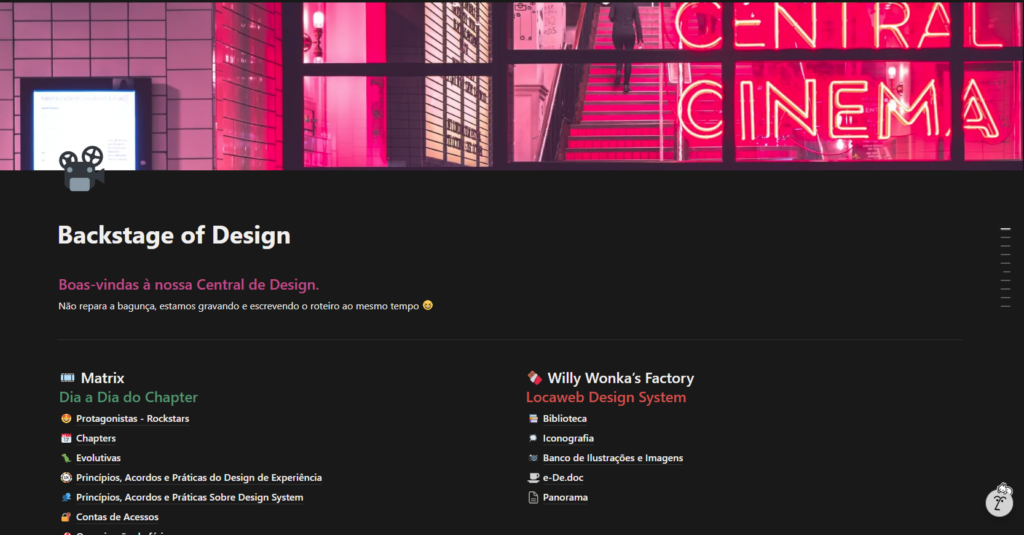
When I joined Locaweb as a Design Lead, it quickly became clear that the biggest bottleneck in design was not talent or technical skill.
It was knowledge.
Critical information was scattered across multiple locations, with no standards, no reliable versioning and, in many cases, stored in personal drives of people who were no longer part of the company. There was no decision history and no clarity on why certain choices had been made.
Every new initiative started from scratch. Every time someone joined or left, the way design operated changed completely.
The turning point came when I identified three different versions of the same strategic document, none of which met the expectations of the executive board. This resulted in an emergency task force to produce a quarterly executive report.
That moment made it clear that knowledge disorganization was not just an operational issue.
It was a direct threat to strategy and to the credibility of design.
I defined a clear and non-negotiable vision:
Design needed an evolutionary knowledge base, independent of specific individuals, capable of sustaining excellence, scale and strategic decision-making over the long term.
This base should not only document the past, but also ensure future direction, even in the face of team or leadership changes.
PAP was a design compliance document that consolidated all agreements related to:
Each PAP agreement was supported by practical guides, video lessons and complete documentation within the Design Hub. All of this content was created and maintained by the designers themselves.
The main goal of the Evolution Ritual was to resolve design team tensions and ensure that action plans did not get lost over time. It was a biweekly ritual with participation from the entire design team.
A facilitator and a note-taker were democratically elected. These roles rotated every three months, giving anyone interested the opportunity to develop facilitation skills.
The meeting was divided into two parts:
A tension was defined as any technical, human or process-related impediment affecting people within design.
Resolved tensions generated learning, and that learning was formally documented in the Design Hub.
More complex tensions generated action plans. The outcomes of those plans directly fed the Design Hub, creating new guides, standards and even new PAP agreements.
Nothing was lost. Everything evolved.
The knowledge base was structured into clear, navigable sections:
It was designed to be used every day, not just consulted occasionally.
Every new designer started with an onboarding document containing a clear checklist of what they would find in the Design Hub and across the company.
In the “Design day-to-day” section, new team members created their own profiles, sharing information that facilitated connection, collaboration and recognition within the team.
The result was a significant reduction in dependency on others early in the onboarding journey.
Everyone could contribute to the Design Hub.
Governance came from the agreements defined in PAP.
As a leader, I defined access levels and autonomy boundaries. From a security perspective, version history and change tracking ensured reliability and peace of mind.
Anyone could challenge agreements, disagree or propose new solutions. The Evolution Ritual was the appropriate channel for these discussions, ensuring that proposals were meaningful, that designers did not waste time creating isolated templates or making unilateral decisions, and that ownership emerged in a healthy and balanced way.
The system was living, adaptable and collective.
The strongest indicator of success happened naturally: during my vacation.
Design operations continued without crises, bottlenecks or dependency on my leadership.
My role shifted from constant teaching to addressing occasional questions. This gave me more time to focus on company strategy and to bring new perspectives and practices into the discipline.
The team itself assumed part of the responsibility for evolving the discipline, supported by specialists in Design Ops and Research Ops.
The Design Hub ensured something fundamental for Locaweb:
Design knowledge and decision history do not disappear, even if everyone leaves the company. Evolution, direction and the ability to innovate remain protected.
It became a strategic asset that prevents stagnation, rework and shallow decision-making when the company is challenged to innovate.

It will be a pleasure to talk about projects,
aspirations, and opportunities.